Quelles tendances émergent chez Gratowin Cas
En tant qu'analyste en ligne spécialisé dans les plat...
Consumer goods companies in Bangladesh, covering FMCG, packaged foods, personal care, and household products, serve over 170 million people. Brands like Unilever, PRAN, Square Toiletries, ACI, and Marico supply shampoos, biscuits, detergents, and snacks through kirana stores, street vendors, and modern retail outlets. The FMCG market is valued at around $4 billion in 2025.
Managing field sales teams visiting hundreds of outlets daily is challenging. Representatives face Dhaka traffic, rural roads, monsoon disruptions, and unpredictable retailer schedules. Many companies still use manual tracking via paper beat plans, calls, WhatsApp, or Excel, causing missed visits, incomplete coverage, stock-outs, poor merchandising, and lost sales in a highly competitive market.
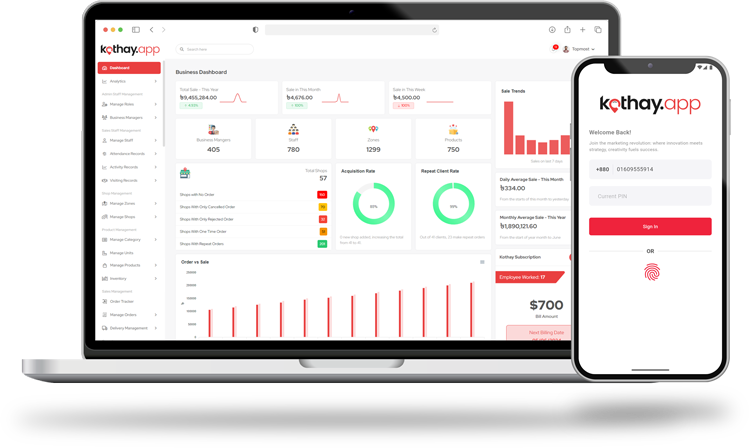
Modern tools like Kothay.app are transforming field sales in Bangladesh. With GPS live tracking, digital visit logging with photo proof, route and zone management, attendance monitoring, and analytics, managers gain real-time visibility. Companies report up to 80% improvements in productivity, retail coverage, and delivery efficiency, replacing guesswork with data-driven, scalable retail operations.
Retail coverage refers to the percentage of targeted retail outlets that a company’s sales team successfully visits, services, and maintains on a regular schedule. In Bangladesh’s context, it measures how effectively field representatives reach kirana stores in Gulshan, tea stalls in Sylhet, or general stores in coastal Cox’s Bazar.
Strong retail coverage delivers multiple strategic advantages:
Poor retail coverage, on the other hand, leads to missed sales, frequent stock-outs, weaker brand presence, and retailers switching to competitors. In Bangladesh, where traditional outlets still dominate (modern retail chains like Shwapno represent only a fraction), even 10–15% gaps in coverage can translate into millions in lost revenue annually. Companies with strong coverage consistently outperform peers in both urban and rural markets.
Despite the market’s growth potential, many consumer goods companies in Bangladesh still operate with outdated manual systems. The consequences are visible every month in lost orders and frustrated managers.
Common challenges include:
These issues are amplified by Bangladesh-specific realities: fragmented rural distribution, high fuel costs, monsoon disruptions, and intense competition for shelf space. Industry reports highlight supply chain inefficiencies and poor distributor performance as major drags on FMCG growth. The result? Lower retail performance, higher operating costs, inconsistent brand presence, and slower response to market shifts , exactly the problems that prevent companies from fully capitalizing on the sector’s untapped potential.
Digital sales tracking tools replace guesswork with accurate data and actionable insights. They provide real-time visibility of sales reps, automated retail visit logging, optimized routes, and performance analytics. By increasing accountability and productivity, these tools ensure every retailer, from urban supermarkets to rural kirana stores, is properly served, merchandised, and stocked, with Kothay.app offering full offline support for Bangladesh.
Key advantages include:
These tools allow managers to ensure every retailer, from high-volume urban supermarkets to small village kirana stores, is properly served, merchandised, and stocked. Kothay.app stands out as a locally built solution that understands Bangladesh’s network challenges, offering full offline functionality and seamless integration of all these capabilities in one platform.
GPS tracking forms the foundation of modern retail coverage management. It gives managers an instant, live view of every sales representative’s location and movement.
Benefits for consumer goods companies include:
With Kothay.app, managers can track all field representatives live on an interactive map inside the web dashboard. They set virtual boundaries around priority zones, receive notifications if a rep leaves their assigned area, and review daily routes for optimization. This feature is particularly powerful in Bangladesh’s mixed urban-rural landscape, ensuring a rep in Dhaka’s Mirpur doesn’t waste time while outlets in nearby Savar remain unserved, or that rural teams in Khulna cover every village store on their beat.
Digital logging replaces unreliable manual reports with precise, automated records that are instantly accessible.
Benefits include:
In Kothay’s Shop Visit Monitoring module, representatives simply check in at each outlet via the mobile app. The system logs the visit with GPS coordinates and a timestamp. Even if no order is placed, reps can submit a quick report with image proof. Every visit links directly to the shop record, creating a transparent history that eliminates disputes and gives managers complete confidence in coverage data.
Efficient route planning turns good coverage into excellent coverage by minimizing wasted time and maximizing outlets visited daily.
Key benefits:
Kothay.app’s Zone Management feature lets companies define territories clearly, assign representatives to specific zones, and create optimized daily routes. Geo-fencing enforces compliance. For a consumer goods company managing 1,000+ outlets across multiple districts, this means systematic coverage instead of chaotic daily improvisation , directly translating into higher product availability and stronger retailer loyalty.
Powerful analytics transform raw field data into strategic intelligence through dedicated dashboards. Kothay enables managers to monitor key metrics such as daily retail visits, orders collected, sales value, territory coverage, and individual performance. With Business, Sales, Product, and Staff Activity Analytics, reports can be filtered by rep, zone, date, or product line, helping reward top performers and address training or coverage gaps efficiently.
Key metrics consumer goods companies monitor include:
Kothay provides Business Analytics, Sales Analytics, Product Analytics, and Staff Activity Analytics. Managers can filter reports by rep, zone, date, or product line (e.g., “How many personal care displays were verified this week?”). This visibility helps quickly reward high performers, identify training needs, and reallocate resources to underserved areas , turning coverage from a vague goal into a measurable KPI.
For consumer goods, what happens inside the store matters as much as the visit itself. Product placement and merchandising directly influence sales.
Benefits of photo capture include:
Kothay.app makes visual monitoring effortless. Field representatives can take and upload high-quality shop photos during every visit. Images are automatically tagged with date, time, GPS, and shop details. Managers review them instantly from the dashboard , perfect for confirming whether a new detergent promotion is visible in rural stores or whether biscuits are properly stocked at eye level in urban outlets. This visual proof eliminates “he said, she said” discussions and drives genuine merchandising excellence.
Field staff work outside traditional offices, making fair and accurate attendance monitoring essential for maintaining coverage.
Benefits include:
In Kothay.app, sales staff log attendance through a simple check-in/check-out in the mobile app. The system records exact times and connects them to GPS location and visit history. Detailed attendance reports are available instantly for payroll and performance reviews. Larger teams can opt for biometric login in the Custom plan. This feature ensures that coverage targets are met by real working hours, not just claimed presence.
Sales tracking tools also create seamless two-way communication channels that were impossible with manual systems.
Benefits include:
Kothay allows managers to send notifications, set targets, and receive instant reports or photos directly through the app. This improved coordination keeps field teams aligned with head-office priorities, crucial when launching seasonal promotions or responding to competitor moves in fast-moving categories like snacks or household cleaners.
While this guide focuses on consumer goods and FMCG companies, the same approach delivers outstanding results across any retail-heavy sector in Bangladesh:
Any business whose success depends on consistent point-of-sale execution and broad retail coverage gains immediate value from digital tracking tools.
Kothay.app is a comprehensive, end-to-end platform built specifically for consumer goods distributors and sales teams in Bangladesh. It combines real-time GPS tracking, digital retail visit logging with photo verification, offline support, route planning, zone management, attendance tracking, and performance dashboards. Designed to scale with businesses of any size, it helps optimize territories, boost productivity, and improve retail coverage efficiently.
Key capabilities include:
The platform scales effortlessly, Basic plan for smaller teams (up to 25 zones), Advanced for growing companies (up to 100 zones), and Custom for large networks. All plans include Shop Management, Shop Visit Monitoring, and image proof features from day one. Testimonials from Bangladeshi CEOs and sales directors highlight how Kothay has optimized territories, boosted productivity by up to 80%, and delivered measurable improvements in retail coverage and sales performance.
Technology continues advancing field sales management in Bangladesh.
Emerging trends include:
Kothay continues evolving with these advancements, ensuring consumer goods companies in Bangladesh stay ahead as the market grows toward its full potential in the coming years.
Strong retail coverage is essential for consumer goods companies in Bangladesh to boost sales, maintain brand presence, and build retailer relationships. Manual tracking leads to missed visits, poor merchandising, and lower performance in a $4 billion market. Kothay.app offers real-time GPS tracking, photo-verified visit logging, route planning, attendance monitoring, and analytics, all offline-ready.
By adopting Kothay, companies can increase retail coverage, improve field productivity, ensure perfect in-store execution, and drive revenue growth.
Visit kothay.app to start your free trial and empower your sales team to deliver stronger results.
En tant qu'analyste en ligne spécialisé dans les plat...
Dans l’univers compétitif des casinos en ligne, Luck...

Managing time well is key for sales reps. You juggle cl...
Sign up now to simplify your sales operations, improve productivity, and make data-driven decisions. Choose your plan, add your team, and unlock the full potential of your sales strategy. Don’t wait – elevate your sales management game and drive success with us!
Get Started