ডিস্ট্রিবিউশন ব�
ডিস্ট্রিবিউশন ব্যবস...

Retailers and wholesalers today operate in a fast-moving market where orders come from multiple channels: physical stores, field sales representatives, distributors, and increasingly, digital platforms. Managing these orders manually using notebooks, phone calls, or spreadsheets often leads to delays, stock mismatches, and costly errors. As businesses grow, these outdated methods make it difficult to track orders accurately, manage inventory, and ensure timely delivery.
An Order Management System (OMS) solves these challenges by digitizing and automating the entire order process. From order placement to fulfillment and delivery tracking, an OMS provides a centralized platform where businesses can monitor everything in real time. This improves accuracy, reduces manual work, and helps companies respond faster to customer demands.
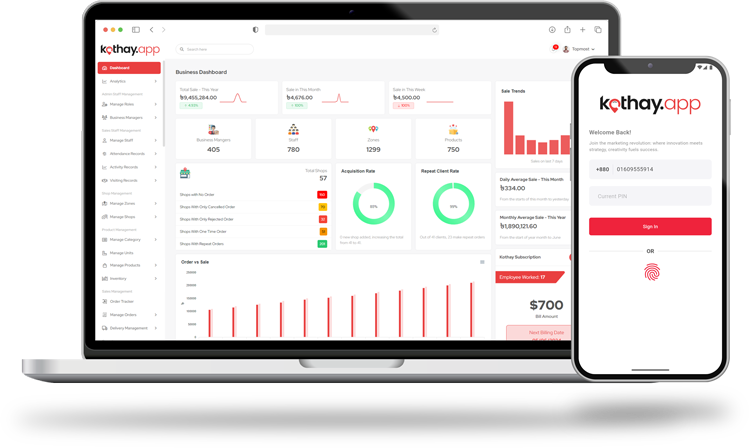
For retailers and wholesalers in Bangladesh, where traditional trade still dominates, and field sales teams play a critical role, modern OMS platforms are especially valuable. Solutions like Kothay.app combine order management with field sales tracking, allowing sales representatives to capture orders instantly using their smartphones, even in areas with limited internet connectivity. Managers can view live dashboards, track sales activities, and monitor order status from anywhere.
With better visibility into inventory, faster order processing, and improved coordination between sales teams and warehouses, businesses can reduce operational errors and increase efficiency. Ultimately, adopting an Order Management System empowers retailers and wholesalers to scale their operations, improve customer satisfaction, and stay competitive in an increasingly digital marketplace.
An Order Management System (OMS) is specialized software that oversees the complete order lifecycle from the moment a customer or retailer places an order until payment is received and delivery is confirmed. It acts as a single source of truth, connecting sales teams, warehouses, distributors, delivery partners, and even accounting systems.
Unlike basic inventory tools or spreadsheets, a true OMS handles complex, multi-channel operations in real time. It is especially valuable for retailers and wholesalers dealing with high volumes, multiple SKUs, and field-based sales.
Key Functions of an OMS include:
Why it matters: In Bangladesh’s fast-growing retail and wholesale sector (projected CAGR of 7.8% through 2031), an OMS provides real-time visibility that manual systems cannot match. It reduces order processing time from hours or days to minutes, prevents costly errors, and ensures customers, whether shop owners or end consumers, receive accurate updates. The result is higher satisfaction, faster cash flow, and the ability to scale without proportional increases in staff or overhead.
Retailers and wholesalers relying on manual processes encounter daily operational headaches that directly impact profitability and growth.
Common Challenges include:
These issues are widespread in Bangladesh’s FMCG, pharmaceutical, electronics, and consumer goods sectors. Manual reporting means no real-time insights, leading to poor demand forecasting and inefficient resource allocation. The consequences are severe: lost sales opportunities (often 5–10% of potential revenue), dissatisfied customers switching to competitors, higher return rates, and tied-up capital in excess inventory. In a market where retailers expect same-day or next-day delivery, these inefficiencies can stall growth and erode margins.
Modern OMS platforms are mobile-first, offline-capable, and designed for emerging markets like Bangladesh. Here are the essential features that deliver real impact:
Centralized Order Processing
All orders from store counters, field reps, distributors, or online flow into one platform.
Benefits: Faster processing (often 40–70% quicker), drastically reduced manual errors, and streamlined workflows that eliminate back-and-forth calls.
Real-Time Inventory Management
The system syncs orders instantly with stock levels across locations.
Features: Automatic updates, low-stock and expiry alerts, overselling prevention, and batch/lot tracking (critical for pharma and perishables).
Order Tracking and Status Updates
Live visibility from confirmation to delivery.
Key capabilities: Instant notifications, processing status, GPS shipment tracking, and automated customer/retailer updates via SMS or app.
Multi-Channel Order Management
Seamless integration of orders from physical retail stores, field sales reps, distributor networks, WhatsApp orders, or basic e-commerce. Everything consolidates in one dashboard.
Reporting and Analytics
Powerful insights, including sales performance by territory/SKU, order fulfillment rates, customer purchasing patterns, and demand trends. Exportable reports help with quick decision-making.
Platforms like Kothay.app excel with Bangladesh-specific additions: store-wise order management, order editing until delivery, geo-fencing for territory control, and full offline functionality for rural areas.
Adopting an OMS delivers measurable, compounding advantages:
Faster Order Processing
Automated workflows and mobile capture cut processing time dramatically. Orders move from field to warehouse instantly, enabling same-day fulfillment even in congested cities.
Improved Accuracy
Digital validation and auto-sync reduce human errors by 60–80% in many implementations. Correct quantities, prices, and stock checks happen at the point of order.
Better Inventory Control
Real-time visibility prevents stockouts (reducing lost sales) and overstocking (cutting carrying costs by 15–30%). Expiry alerts protect margins on perishables and medicines.
Enhanced Customer Experience
Retailers and end customers receive accurate delivery ETAs, live tracking, and fewer errors. This builds loyalty, especially important when competing with modern retail chains.
Increased Operational Efficiency
Staff shift from paperwork to selling and relationship-building. Managers gain instant oversight, reducing oversight time and enabling proactive problem-solving.
Industry studies show impressive returns: one Forrester analysis of modern OMS deployments reported 167% ROI, $8 million net present value over three years, and payback in under six months through faster fulfillment, higher order values, and optimized operations. In Bangladesh, pilots and businesses report 40–50% faster order cycles and significant reductions in complaints.
Retail Businesses
Small and medium retailers manage in-store and field orders simultaneously. An OMS lets counter staff or reps place orders instantly while headquarters monitors stock across multiple outlets in real time.
Wholesale Distributors
Wholesalers handling bulk orders from hundreds of retailers use OMS for order validation, credit checks, and coordinated deliveries. Store-wise tracking ensures accurate fulfillment to kirana shops or rural wholesalers.
E-commerce Businesses
Even hybrid models (online + offline) benefit. OMS integrates marketplace or basic web orders with physical stock, preventing overselling and enabling fast last-mile delivery.
Field Sales Operations
This is where tools like Kothay.app shine in Bangladesh. Sales representatives visit outlets, capture orders on mobile (with photos or signatures), and trigger automatic warehouse updates. Managers see live order pipelines, visit compliance, and territory performance.
In practice, a Dhaka-based electronics wholesaler using such a system reduced order errors by over 70% and increased daily order volume without adding staff. A pharmaceutical distributor achieved near-perfect stock availability at pharmacies through real-time alerts.
While benefits are clear, SMBs in Bangladesh often hesitate due to practical hurdles:
Rural connectivity issues and power outages add another layer in Bangladesh. However, modern offline-capable platforms minimize these risks.
Selecting the right OMS is critical. Evaluate these criteria:
Why mobile-first systems are important: Most orders in Bangladesh originate from field sales reps or store visits outside office hours. A phone-based OMS lets teams work anywhere, syncing data automatically when connectivity returns.
Kothay.app is particularly suited for Bangladeshi retailers and wholesalers because it was built locally, focusing on field order capture, real-time tracking, and affordable pricing.
Successful adoption follows a structured approach:
Businesses that treat implementation as a change-management initiative (with incentives for app usage) typically achieve 90%+ adoption and full ROI within 3–6 months.
The OMS landscape is evolving rapidly, especially with AI and mobile advancements:
By 2026, AI-driven “agentic” systems will handle routine decisions autonomously, allowing retailers and wholesalers to focus on growth while maintaining resilience against disruptions.
Kothay.app is a locally developed, mobile-first platform that delivers robust order management tailored to Bangladesh’s unique challenges, combining field team tracking with powerful order workflows.
Key Capabilities include:
Sales reps capture orders at the point of sale (even offline), with automatic sync to warehouses. Managers get alerts for delays or low stock and can reassign tasks instantly. Features like beat planning and route optimization further enhance delivery efficiency.
In real Bangladeshi implementations, businesses using Kothay.app have achieved 46% faster order processing, 98% on-time delivery rates (up from 81%), and a 60% drop in customer complaints. Field teams cover more outlets daily while headquarters maintains complete visibility, perfect for retailers, wholesalers, and distributors in FMCG, pharma, and consumer goods.
For Bangladeshi businesses, the platform’s Bengali support, affordable SaaS pricing, and understanding of local issues (traffic, rural connectivity, power outages) make it a practical game-changer rather than a complex enterprise tool.
Efficient order management is critical for retailers and wholesalers in today’s competitive market. Manual methods often cause delays, errors, and poor visibility, making it difficult for businesses to scale and serve customers efficiently.
A modern Order Management System simplifies the entire process by automating order capture, tracking, and fulfillment. Platforms like Kothay.app help businesses manage orders in real time, coordinate field sales teams, and improve inventory accuracy all from a single platform.
If you want faster order processing, fewer mistakes, and better control over your operations, now is the time to switch to a smarter solution.
Visit Kothay.app today to register, request a demo, and start managing your orders more efficiently.



Online shopping in Bangladesh is booming, with the e-co...
Sign up now to simplify your sales operations, improve productivity, and make data-driven decisions. Choose your plan, add your team, and unlock the full potential of your sales strategy. Don’t wait – elevate your sales management game and drive success with us!
Get Started