Pourquoi les débutants font confiance à Cbe
Une plateforme sécurisée et accessible pour tous Cbet...

You use salesman tracking software to monitor and organize your sales team for the field force. But are you doing the sales tracking the right way? There are some common sales tracking mistakes that can become hurdles to growth.
Some mistakes can’t be seen with the naked eye. If you only depend on numbers, you won’t be able to understand why the graph is showing poor performance. I’ve seen several companies that invest hundreds of dollars in monitoring and tracking sales rep activities. But they still can make the field force perform better.
Today, we will go beyond mentioning the common sales mistakes. We’ll also tell you how to handle the issues in the best way possible.
First, understand what sales tracking is for in your business upscaling.
You measure your team’s performance to understand the improvement rates, places where your team can improve, etc. Sales tracking or salesman tracking means recording, organizing, and analyzing every interaction, existence, transaction, lead movement, rep’s activity, stage of the whole pipeline. You are not getting numbers from tracking. You are getting an overall summary of your sales team’s dones and undones.
For example, your sales reps are distributing your goods in 10 different locations. You’re selling quite well, but the growth is dead. If you go through the tracked records, you’d understand which location has the fewest customers, which sales rep is unable to increase sales, where the delivery is getting stuck, what doable is taking too much time, etc.
A strategic salesman tracking will help you see who performs well, which zones aren’t aware of your brand, and where your deals break. You can forecast growth, shape training, and use resources wisely.
Even in 2025, especially in Bangladesh, small businesses use spreadsheets, notebooks, and pads to record salesman data. Even the entry-exit of reps is recorded on the tally books. Here, the more you rely on manual work, the bigger your chances of having errors, duplicate data, and missing records in your sales process.
Apart from it, manual recording reduces productivity and increases time wasted. The processing of all this scattered data into one final report also takes multiple working days.
Imagine a field rep returning to the office after on-field duties and completing the sheets from their memory and guesswork. This will lead to loss of resources and poor forecasting.
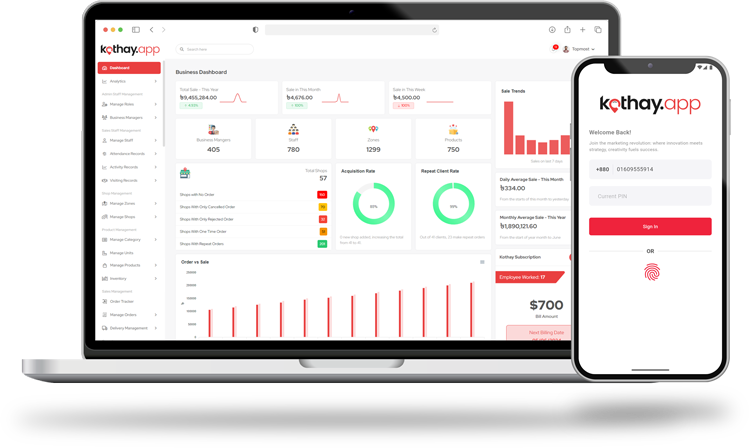
The easiest way to avoid such errors is by shifting to Kothay, an automated salesman tracking software that you can easily manage to monitor and analyze your sales team’s performance.
What’s more, Kothay is very affordable. You can check their pricing here.
Tracking only how many hours your employees have worked isn’t enough. Final sales numbers aren’t the real outcome. You need to track immediate actions like locations visited, breaks taken (when and where), calls engaged, sales done, visits confirmed, proposals sent, etc.
Most of the authorities or territory officers keep these blind spots ignored and create wrong sales forecasting. You need to analyze each sales rep’s activity individually.
Modern CRMs and tracking apps support detailed reporting that helps to manage your sales team properly. You have to integrate them into your system for better outcomes.
Many businesses fail to know what field reps do day to day. Are they actually visiting shops? Are they inside zones? Without visibility, reps may report false visits or drift between territories.
You end up planning based on guesses, not real behavior. GPS-based tracking and geo-verification address that. With GPS-enabled solutions like Kothay, you see daily routes, visits, and check-ins without micromanaging.
When each rep or region uses its own format, data becomes inconsistent. One manager reads “10 calls, 3 deals,” another sees “3 deals, 10 calls,” another shows “visits, orders.”
Such variation causes miscommunication between teams. You cannot reliably roll up metrics.
The fix is that the team needs to adopt templates or central dashboards. Kothay auto-generates daily, weekly, and monthly reports so everyone works from the same data.
Many track only closed deals and neglect leads that are pending, lost, or under negotiation. That is a major common mistake.
Leads in the pipeline might be forgotten, and potential revenue slips away. You miss trends: which stage loses the most leads? From contact to conversion or dropout, you must track each lead through its full journey.
An integrated tool lets you view pipeline progress and pending follow-ups in one place.
Some teams collect data but leave it unused. They see tables of sales numbers but don’t analyze trends or spot patterns.
Data without insight is noise. You need dashboards, trend lines, segmentation, and comparisons. You should monitor conversion rates, territory performance, repeat orders, and drop-off points.
Drive strategy by insight, not by raw data dumps.
Installing a salesman tracker on your employees’ mobiles isn’t enough. They will only focus on fulfilling daily activity times. But when you set targets and KPIs, your field force will focus on fulfilling their deliverables as well.
Putting immense pressure on your team is illogical. But you need to make them feel the pressure of completing their monthly goals; otherwise, they will face consequences. Always set goals, monitor the behaviors or efforts, and use performance reports generated by the sales tracking app to push those employees who are lagging behind and reward those who are showing promise.
When tracking systems require a desktop login, field reps rarely use them. That leads to delays or missing data.
Mobile-first tracking makes updates immediate. Reps can check in, upload receipts, log activity, or report any time. These small real-time entries increase data reliability.
If your sales tracking tool lacks mobile access, adoption will suffer.
If your sales tracker is siloed, you face duplicate data entry, misalignment, and inefficiencies. For example, you might enter orders in the tracking app and again in the invoicing system.
Integration with CRM, ERP, invoicing, or marketing tools prevents that. When data flows seamlessly between systems, you save time and reduce discrepancies.
Linking your tracking tool to other systems reduces common salesforce problems.
Many businesses pick a tool, set it up, then never revisit it. That is a mistake. As your operation scales or changes, your system may lag.
You need to update features, customize workflows, and retrain teams. Review your tools annually or when adding new functions. A system that worked at 10 reps may fail at 100.
Now, let’s give you a small checklist that you can apply for quick fixes to your problems.
The salesman tracking systems like Kothay combine location tracking, route planning, task management, live reporting, performance analytics, and break management. These platforms help you avoid any type of mistake from happening.
Kothay is the best sales rep tracking app in Bangladesh. You can also use this platform to manage your sales team in other countries as well. It has some exceptional features like GPS tracking, geofencing, order management, attendance and break management, and live reporting.
Managers can easily get their employees’ live updates without requesting a call or text message. Sales reps can also focus more on their work over reporting and updating.
The mobile application of Kothay works properly and saves users’ updates even in poor internet zones. Sales management can easily make decisions or forecast without calling for lengthy meetings using Kothay.
The best thing is, this tool gives you a team performance dashboard, shows order progress, and sets zones for coverage. Using Kothay, growing businesses in Bangladesh can manage field teams without costly setups or steep learning curves.
You can also visit our knowledgebase section to know more about Kothay and other sales tactics to improve your sales team’s performance.
You have to record both activities and outcomes together. Then go through conversion rates, pipeline stage successes, and KPIs.
Your salesman tracking system is flawless if it shows real-time data with a detailed report of each employee, where important KPIs are mentioned properly.
To track field force activities, you need to have a system that comes with GPS-based tracking apps, a CRM system with reporting, etc. Kothay gives you all the essential features in affordable packages.
You should go through your sales report once a week to troubleshoot before facing any major issues.
Set clear goals, offer rewards for meeting KPIs, and set some regulations against missing targets.
Poor sales tracking or sales tracking mistakes don’t hide problems; they actually create problems for the whole sales team. But fixing those mistakes in your tracking method is quite easy. You need to focus on the edges or loopholes of your systems that are covered in dust and bring them into the light.
When your tracking tells the full story, your decisions get more accurate. Your team becomes more passionate to contribute. If you’re ready to get these positive changes, try Kothay now. It is a future-proof system that will help you scale up with its versatile management features.
Try Kothay today.
Sign up now to simplify your sales operations, improve productivity, and make data-driven decisions. Choose your plan, add your team, and unlock the full potential of your sales strategy. Don’t wait – elevate your sales management game and drive success with us!
Get Started