AI for Employee and Salesman Tracking: A Comp
Tracking a large group of employees and sales team isnâ...

There are more than 50 FMCG companies registered in Bangladesh. As the country is densely populated, the demand for fast-moving consumer goods is very significant. Some of the best FMCG companies in Bangladesh have contributed the most to jobs, exports, and household consumption.
Top FMGC companies also connect agricultural inputs, manufacturing, retail chains, and marketing in a complex and seamless supply chain.
Today, team Kothay has gathered profiles of the best Bangladesh FMCG companies. It will help you to understand their company overview and contribution to the national economy.
Let’s dive into the list of top FMCG companies in Bangladesh.
Here’s a quick scan of major players in Bangladesh’s FMCG sector.

This quick table helps you see at a glance which companies are large, multinational, or local, and what product areas they cover.
To select the top FMCG companies in Bangladesh, we used the following criteria:
We cross-checked with sources like business directories (e.g., FICCI Bangladesh), company “About us” pages, and recent news articles. That ensures that our discussion on the top 10 FMCG companies in Bangladesh reflects both scale and reputation.

Below you’ll find deeper looks at several major FMCG players in Bangladesh. These fast moving consumer goods FMCG companies in Bangladesh have played a crucial role in the domestic economy and GDP for more than 2 decades. Each of them has a large pool of on-field and in-house dedicated employees to scale efficiently.
Unilever is one of the most established FMCG multinational companies in Bangladesh. It operates in home care, personal care, and health & wellness drinks (since acquiring GSK’s health-food drink business in Bangladesh).

It is part of global Unilever with local operations under “Unilever Consumer Care Bangladesh.” Its annual report shows revenue decline in 2024 vs 2023, but the business remains significant in scale.
Key facts:
Why it matters:
Unilever represents the strength of a multinational company in Bangladesh. It brings global brand standards, R&D, and scale. At the same time, it competes directly with local and regional FMCG firms in home & personal care as well as health-drink segments.
PRAN is one of the leading local FMCG manufacturing companies in Bangladesh. It is owned by a Bangladeshi group (PRAN-RFL) and has a strong export component. The company’s hero items are Mr. Noodles and Frooto.

It began around 1981 and has grown to produce a wide range of food & beverage items. They also own a sweet chain known as Mithai all over the country. Fast food chain Tasty Treat is also part of their core projects.
Key facts:
Why it matters:
As a local FMCG manufacturing company, PRAN illustrates how domestic firms build scale, local sourcing, and export strategy. It competes with multinational companies in the same product categories but benefits from local knowledge and control.
Marico is a multinational company (MNC) that sells personal care, grooming products, edible oils, and other types of goods in similar niches. The company started its operations in Bangladesh in 2000.
Parachute coconut oil and Livon are two of this brand’s main products that are widely available in the country.
Key facts:
Why it matters:
Despite being a foreign-based business, the brand contributes a lot to Bangladesh’s FMCG markets. The corporate office of Marico brings global practices in operations and adapts local preferences as well. All of Marico’s products offer the best price and quality.
Square Toiletries is a local FMCG manufacturing company focused on health, hygiene, and cosmetics. Apart from the FMCG business, the company has other concerns like hospital and security services that generate huge revenues.
It produces many everyday personal care items under several brands. It is part of Square Group, one of Bangladesh’s major conglomerates. Kool, Sepnil, Meril, etc., are the main sub-brands of Square.
Key facts:
Why it matters:
Square is another big name in the FMCG company list in Bangladesh. Among so many local and foreign brands, this name has earned the trust of millions of citizens due to its other projects like health services, packaged food items, etc.
ACI Limited is one of the leading Bangladeshi FMCG companies with multiple businesses in different sectors. Some of their key concerns are consumer goods, pharma, and agro-business. ACI Consumer Brands is the company’s FMCG part that serves millions of households with items like salt, spices, and cleaning essentials.
The company was formed in 1968. Since its early development period, the company has become one of the largest public limited companies in Bangladesh. The head office is located in Dhaka. You’ll see their manufacturing plants in several locations in the domestic lands.
Key facts:
Why it matters:
ACI has earned brand loyalty from its consumers for the top quality in household essentials. Still in 2025, ACI is a powerful name in the FMCG company list in Bangladesh. The diverse business operations can help the group stay stable even during the market shifts.

In recent years, BEXIMCO Group has become one of the largest conglomerates in Bangladesh. Some of their core concerns are cold storage, textiles, pharma, food, and beverages. BEXIMCO Foods and other related ventures are now actively participating in the country’s FMCG sector.
The company was founded in 1972 and started its operation in Dhaka. It also exports to international markets every year. The top-selling products are processed food, beverages, household items, etc.
Key facts:
Why it matters:
BEXIMCO has been producing consumer goods at a large scale for both domestic and export purposes. It has partnered with several other global brands as well. Nowadays, BEXIMCO’s ISP (internet service provider) business has also boomed.
Nestlé Bangladesh, a branch of the Swiss global FMCG giant Nestlé SA, plays a vital role in the country’s food and nutrition market. It operates from its corporate office in Dhaka and a factory in Sreepur, Gazipur. (nestle.com.bd)
The company began operations in 1994, introducing brands that are now household staples — Nescafé, Milo, Maggi, Cerelac, and Nido. Its focus remains on nutrition, health, and wellness.
Key facts:
Why it matters:
Nestlé is a global brand and has offered international-grade food items to local consumers for several years. The pricing of all their products is balanced with the market range. Therefore, the brand has become a top FMCG ecosystem competing with local brands.
Consumer goods like Dettol and Harpic have been an everyday essential for healthcare and hygiene in Bangladesh. From hospitals to homes, these products from Reckitt Bangladesh are always in demand. Reckitt, also known as Reckitt Benckiser, produces hygiene, health, and home products.

Some of the popular products are Dettol, Harpic, Veet, and Durex. All their products became best sellers during the COVID period globally.
Key facts:
Why it matters:
Reckitt’s global expertise and consistent brand trust make it a vital part of the FMCG landscape in Bangladesh. Its hygiene awareness campaigns further add to its social and business impact.
Olympic is one of the oldest and largest biscuit, confectionery, and snack item manufacturers in Bangladesh and South Asia. The company was established in 1979. It operates multiple modern factories to produce biscuits, cakes, noodles, candies, chips, and batteries.
The company has been listed on the Dhaka and Chattogram stock exchanges to expand market shares through trending products.
Key facts:
Why it matters: Olympic Industries is a great example of scale globally by focusing on consistent quality over exaggerated marketing. Quality and value pricing are the core of their products. Their processed goods are acceptable in all economic classes of the country.
Fresh is a sub-brand of Meghna Group of Industries. This part of Meghna Group produces consumer goods on a large scale. Fresh is currently one og the most diversified conglomerates with millions of consumers every month.

Fresh produces several household items that consumers need almost every day. Their hero products are tissues, spices, flour, sugar, oil, tea, etc. Some stats make it one of the 3 best FMCG companies in Bangladesh.
Key facts:
Why it matters:
Fresh has evolved rapidly and grabbed the local market in a very short time. Their international-grade processing and packaging have won the trust of millions locally and globally.

Looking across these companies, you can compare their strengths in revenue, exports, product-category leadership, and whether they are local businesses or multinational companies.
As the FMCG sector covers different categories, like food, nutrition, healthcare, kitchen items, hygiene, daily essentials, etc., it’s hard to determine the overall best brand.
However, one thing is very common among the domestic production companies. They tend to have tighter control over the domestic supply chain, putting them in a firm position in Bangladesh’s economy.
Whereas, global brands try to take over the market by bringing their global heritage to product quality and combining the local cultures.
When you break down the FMCG sector by category, you see clear leadership by different companies:
This map helps you see that no single company dominates all categories. Instead, different players specialize in different niches or combine strengths across a few.

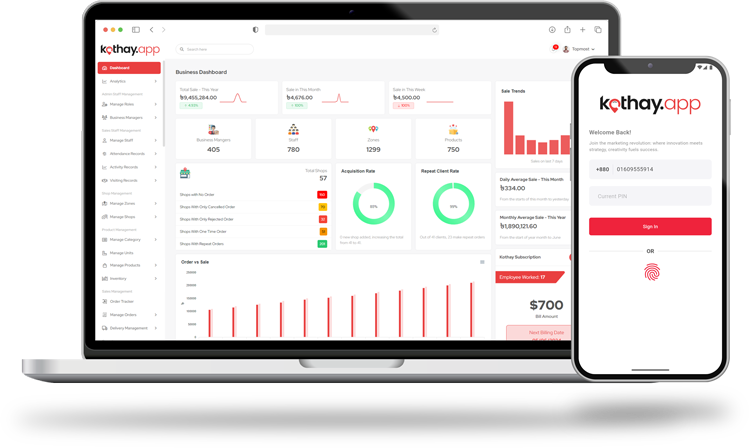
You might ask why we mentioned Kothay in the article on FMCG companies in Bangladesh. FMCG companies heavily rely on sales reps and distributor networks. Companies need real-time data to track progress and forecast sales efficiently.
So, Kothay sales tracking software can support a domestic FMCG business in many ways:
If you work at or with any of these top FMCG companies in Bangladesh (or lesser-known ones), implementing a tracking solution like Kothay can improve decision-making, reduce inefficiencies, and raise sales effectiveness.
Which is the largest FMCG company in Bangladesh?
The largest FMCG company by brand reach and recognition is often considered Unilever Bangladesh, due to its multiple product lines across home, personal care, and strong market share across categories.
Is PRAN a local or multinational FMCG company?
PRAN (PRAN-RFL Group) is a local Bangladeshi FMCG and manufacturing company. It produces and exports many food & beverage products globally.
Does Marico Bangladesh export products outside the country?
Marico Bangladesh operates locally with brands and as part of a multinational, but its core business mostly targets domestic consumers. Its exports are more limited compared to fully export-oriented FMCG manufacturers.
What is the meaning of the FMCG company or the FMCG full form?
FMCG stands for Fast Moving Consumer Goods. An FMCG company manufactures consumer products that are sold quickly and at relatively low cost, such as food items, personal care, and household goods.
How can FMCG companies in Bangladesh verify their sales network performance?
They often track distributor performance, field sales calls, order fulfillment rates, and stock levels. Using a software tool (e.g., Kothay) to track sales visits, monitor outlets visited, and analyze gaps helps verify performance.
The FMCG companies in Bangladesh will keep growing as urbanization in the country continues. The competition between local and international sellers will become more intense in the upcoming years.
Companies that perform data-driven sales management, integrate seamless sales and employee tracking, produce more innovative products, and create a strong supply chain can only remain more relevant to the targeted consumers.
If you also want your company to stay ahead of your competitors in the FMCG market, keep track of your sales team with automated solutions. Use Kothay to centralize all your sales data in one place and create a better sales strategy.

Tracking a large group of employees and sales team isnâ...

I see you out there, managing a pharmaceutical sales te...

Daily attendance reports are essential for managing sal...
Sign up now to simplify your sales operations, improve productivity, and make data-driven decisions. Choose your plan, add your team, and unlock the full potential of your sales strategy. Don’t wait – elevate your sales management game and drive success with us!
Get Started